
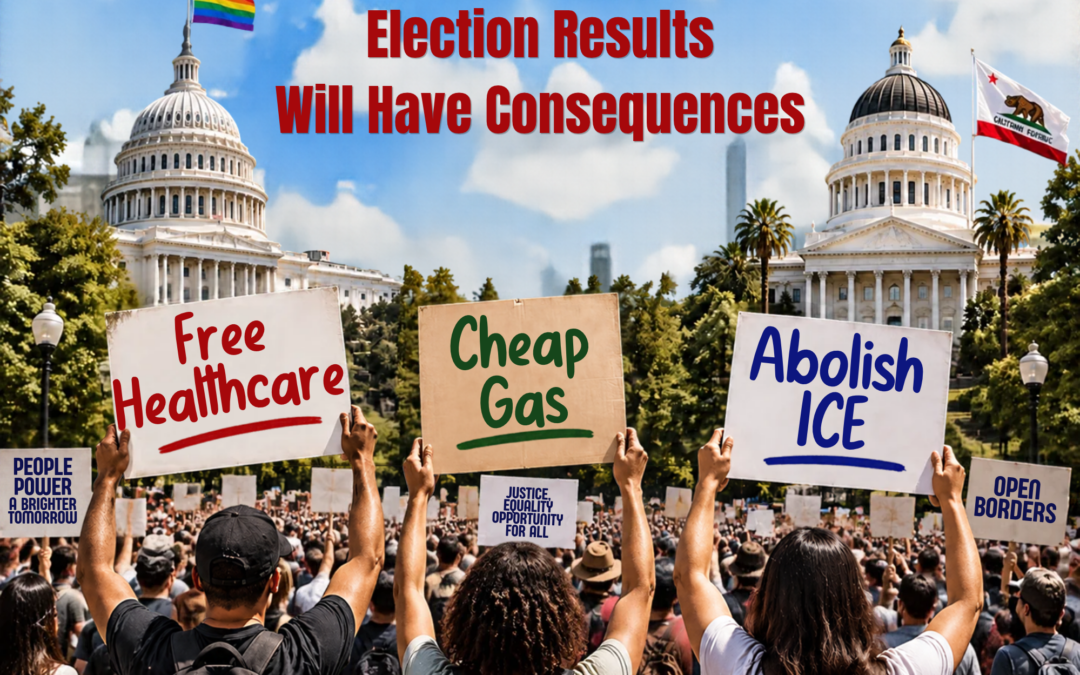
The 2026 Election was painful for Republicans and we can only improve going forward.
No doubt, those who watch the Democrats take over Washington will see little work on affordability, and too much emphasis on discrediting President Trump and his administration. With the election just concluded, it is already a toxic environment, and I expect most voters to just tune it out while they wait to see if prices go down.
Meanwhile in California…Republicans now hold 7 seats in the State Senate and 12 seats in the Assembly. Just four Republicans were elected to Congress, including Tom McClintock in District 5, Vince Fong in District 20, Jay Obernolte in District 23, and Ken Calvert in District 40.
According to an AP poll of CA voters, 38% said the economy influenced their vote; 36% were concerned about the state of Democracy, 12% immigration. and 7% healthcare. Foreign policy was 4% and crime 3%.
There were some wins and losses with statewide ballot measures.
- Conservatives opposed Prop 1 (Bonds for housing) which won with 60.3%, Prop 2 (slush fund for a rainy day) with 59.8%, Prop 3 (made permanent a high income earner tax) with 61.9%, and Prop 5 (Recall reform) passed with 50.2%.
- The only winner for conservatives on measures placed by the Legislature was the defeat of Prop 4 (enabling public financing of campaigns) by 51.95%.
Progressive voters prevailed in most state initiatives over conservative opposition:
- Prop 37 Housing Bond, and Prop 38 Immunology Bond passed, while defeating pro-taxpayer and election integrity measures Prop 39 (Voter ID), Prop 41 (Government Program Audits), Prop 43 (Local Tax Limits), and Prop 45 (CEQA Reforms).
- Conservative/taxpayer victories included defeating Prop 40 (taxing unrealized assets) and passing Prop 42 (meant to cancel out Prop 40 taxes).
- A non-partisan victory was achieved with the defeat of Prop 44 (union effort to take over rural health clinics).
In Sacramento County, every tax increase at the local level passed with no visible campaigns to oppose these new bonds.
With a few provisional ballots still to be counted, in the Sacramento region, we tragically lost Assemblyman Josh Hoover in AD 7 (46.7% to 53.3%) but thankfully re-elected Senator Roger Niello in SD 6 (50.6% to 49.4%).
Republican Assemblyman Heath Flora was re-elected in AD 9 56.3% to 43.7% after an unsuccessful challenge from the far right in the Primary. Other legislative seats in the region were either unchallenged or had weak Republican candidates who had no visible campaigns.
It became clear that the far right, who currently controls the SacGOP Central Committee, was too focused on recruiting candidates who would tow the line as CAGOP delegates and Central Committee ex-officio’s, rather than running visible campaigns in their districts. They didn’t put up a candidate to run in AD 6 or AD 11. The lack of visibility in the legislative campaigns was evident to voters who must think Republicans have given up on Sacramento County.
Republican voters did step up in CD 7 to put Democrat Doris Matsui over her socialist challenger Mai Vang (52.4% to 47.6%). Former Senator Richard Pan defeated Congressman Kevin Kiley (58.8% to 41.2%) in CD 6, a district redrawn by Democrats to wipe out the conservative Congressional delegation. Too many Republicans abandoned Kiley after he switched his registration to NPP, even though there was no Republican running. The Prop 50 strategy also succeeded in electing Rep. Ami Bera over Robb Tucker in CD 3 (58.7% to 41.3%). Tucker had soundly defeated far right perennial candidate Chris Bish in the Primary in spite of her negative campaign focused on Tucker rather than Bera. But the Prop 50 maps prevailed allowing Bera to represent a district where he does not live.
In Sacramento County, no Republicans were recruited to run for the Board of Supervisors, and no Republicans were recruited to run for City Council in the City of Sacramento in June. In Folsom, Republicans Mike Kozlowski won re-election (by 1400 votes over closest challenger) as did Anna Rohrbough (by 491 votes). Republican Tom Silva beat incumbent Democrat Paul Sandhu (by 81 votes) in Galt, and in Citrus Heights, Republican Marijane Lopez-Taff won re-election (by 1478) over her Republican challenger, and Republican Dr. Jayna Karpinski-Costa was re-elected over her Republican challenger (by 455 votes). No Republican candidate challenged incumbent Porche Middleton in Citrus Heights. In Rancho Cordova, there again was no Republican candidate challenging Elliott Stevenson, and Lilia Darbinyan was the spoiler, taking away conservative votes from incumbent Linda Budge who lost by 165 votes to Tegan Mauldin. The lone Republican running for Elk Grove City Council was Peggy Parks who did campaign, but lost to incumbent Sergio Robles.
Congrats to Natasha Thao and incumbent Nancy Anderson who were elected to the Center Joint USD, and Jen Laret who was unchallenged in Folsom Cordova USD. Chris Fredrich had a credible campaign in Folsom Cordova, but came up short by 871 votes. Incumbent Craig DeLuz lost re-election in the Robla Elementary School District, and Morri Elliot worked hard but came up short in San Juan USD by just 550 votes. Congrats to Manuel Perez and Tanya Kravchuk (unchallenged) who won re-election in San Juan.
No Republicans were recruited to run for SMUD seats, but there were a few victories at the Water District level with George Machado, Ted Costa and Manny Zamorano winning re-election by large margins in San Juan Water District.
Hopefully lessons will be learned from this 2026 election, namely to recruit serious candidates in seats where Republicans can be competitive, and support them with effective communications to conservative voters! Stuffing envelopes cannot replace targeted social media, texting, walking, and email campaigns with messaging that is relevant to voters.
Republicans will have the opportunity to run for Central Committee seats in the 2028 Presidential Primary. In order to have a better election outcome, we will need a new generation of conservatives to run for these positions who have modern communication skills and a willingness to engage voters in all communities.
We are learning the hard way that failing to effectively take the lead in elections has consequences. We can overcome the results of 2026 if we face the reality that we must bring the Republican Party into the new world of technology, while continuing to fight for election integrity, and acknowledging voter intolerance for partisan gridlock.